

‘The Russian-Chinese Partnership: A Stabilising Factor in the World’
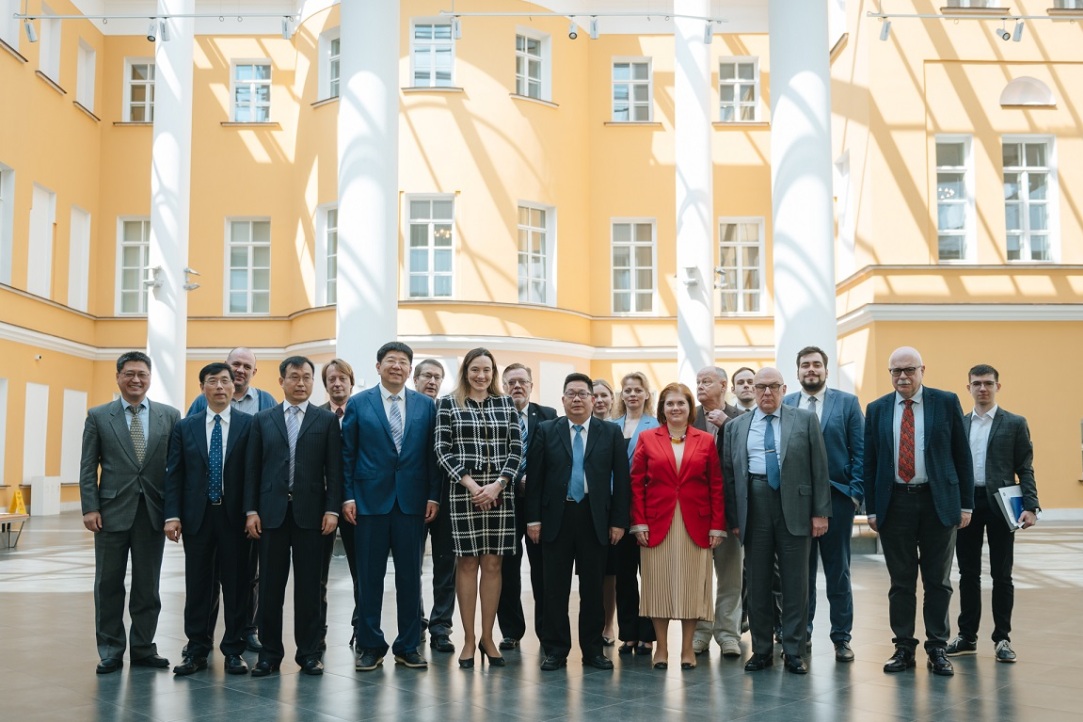
A delegation from the Chinese Academy of Social Sciences (CASS) visited HSE University. As part of the visit, a roundtable discussion on ‘Russia and China: Comprehensive Partnership and Strategic Interaction in a New Era’ was held. Participants discussed issues related to the Russian-Chinese strategic interaction in global and regional security, finance, trade, and investment. The meeting was moderated by Victoria Panova, Vice Rector of HSE University, Head of the BRICS Expert Council–Russia, and Russia's Sherpa in the ‘Women's Twenty.’
‘This year we celebrate the 75th anniversary of the establishment of diplomatic relations between Russia and the People’s Republic of China. Russian President Vladimir Putin is currently on a state visit to China, the first visit after his inauguration. This is a significant sign for us, and in this context, our discussion takes on special significance. Moreover, today's roundtable is taking place during Russia's presidency in BRICS, where Russia and China play a special role,’ said Vice Rector of HSE University, Victoria Panova, in her opening remarks at the expert discussion.
Victoria Panova
She also expressed the commitment to sincere dialogue and emphasised that the aspects of the partnership between HSE University and CASS meet the national interests of both countries, serve as a stabilising factor for the entire world, and effectively promote the agenda of the global majority.
Timofey Bordachev, Academic Supervisor of the Centre for Comprehensive European and International Studies at HSE University, Head of the Section for BRICS National Strategies and Country Analysis of the BRICS Expert Council–Russia, outlined the prospects for cooperation between CASS and HSE University.
Timofey Bordachev
‘The topics we are discussing today will certainly become the focus of scientific projects and research. These issues can be divided into two groups: the first is topics of the current wartime and how Russia and China respond to Western pressure; the second is topics of peacetime, such as what the international order we aspire to will be like,’ the expert explained.
Sergey Avakyants
Sergey Avakyants, Director of the HSE Institute for Global Military Economics and Strategy, also shared his views on the prospects for the development of the partnership between Russia and China. ‘The strategic partnership between the two countries should go further and move towards the creation of joint scientific teams that will permanently engage in both practical developments and fundamental research in various fields,’ he believes.
The Chinese colleagues thanked the administration of HSE University for the warm welcome and acknowledged the high level of relations between the countries.
Zhang Guanzi, member of the Chinese People's Political Consultative Conference, Secretary General of the Board of Directors, National Top Think Tank, CASS, President and senior research fellow at the Institute of Academic Information Studies, CASS, noted that CASS considers HSE University a reliable and respected partner for long-term cooperation.
‘We highly value the professionalism and expertise of HSE University. Russian-Chinese relations are developing progressively, forming a coalition responsible for a new world order that should replace American global hegemony. Russia and China are the core of this coalition. The issues raised by Victoria Panova and Timofey Bordachev are of great interest to us,’ he said.
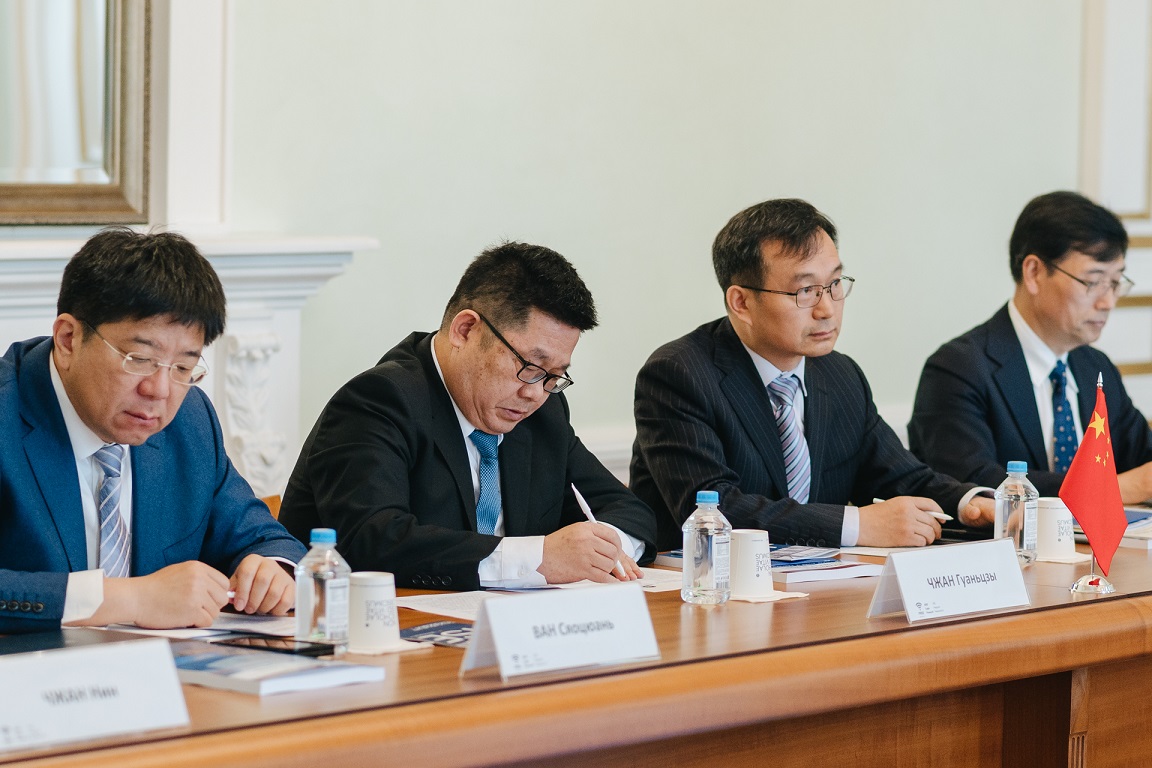
Wang Xiaoquan, Head of the Secretariat of the National Top Think Tank at CASS and Chief Research Fellow, added that both countries are actively participating in the reconstruction of the world economy. The Belt and Road Initiative and the Greater Eurasian Partnership are of great importance for the development of the continental economic zone. It is necessary to strengthen economic and humanitarian ties together and adapt to new conditions.
‘The trend towards multipolarity in the world is becoming increasingly evident: new world power centres are forming, many of which are located in the Eurasian space. Countries that can become centres of a multipolar world and lead the restructuring of global production chains must possess not only extensive economic resources but also strong comprehensive power, like Russia and China—the two largest world economies,’ Wang Xiaoquan believes. ‘Both countries are actively involved in the reconstruction of the world economy: China is making efforts to achieve high-quality development, and Russia is pursuing a policy of import substitution.’
Victoria Panova thanked the participants of the expert discussion for a productive dialogue and expressed confidence that the results of the discussion would make a valuable contribution to further cooperation between Russia and China and to the promotion of the agendas of both countries on the world stage.
See also:

HSE and Tsinghua University Strengthen Russia–China Partnership as part of Cross Year of Education
On May 10, a delegation from Tsinghua University—one of China’s leading higher education institutions—paid an official visit to HSE University. The delegation was led by Qiu Yong, Secretary of the CPC Tsinghua University Committee, former President and Chair of the University Council, and member of the Chinese Academy of Sciences.
HSE University Signs Cooperation Agreements with Leading Chinese Universities
On May 8, 2025, in Moscow, in the presence of Russian President Vladimir Putin and Chinese President Xi Jinping, strategic agreements were signed between the HSE University and two of China's top institutions, Peking University and Tsinghua University. The event was attended by Nikita Anisimov, Rector of HSE University, Qiu Yong, Secretary of the CPC Tsinghua University Committee, and Gong Qihuang, President of Peking University. The signing unfolded during the official visit of the Chinese delegation to Russia, coinciding with the commemoration of the 80th Anniversary of Victory Day.
‘The Most Important Lesson I've Learned at HSE Is the Power of Collaboration’
Jingtao Xu (called Andy in English) earned a Bachelor’s degree in Data Science and Business Analytics at HSE University–Moscow and is now studying on the Master’s in Math of Machine Learning. In this interview with the HSE News Service, Andy talks about his plans to develop his robotics research into a commercial product, how online shopping in Moscow has improved since he first arrived, and why now is a good time to capitalise on Russian–Chinese cooperation.
Russian and Chinese Scholars Share Experience of Transformation of Doctoral Education
The Russian and Chinese postgraduate education systems originally borrowed their institutional frameworks from the Soviet Union. However, in the 21st century, they have evolved along different paths. While key performance indicators for postgraduate programmes in Russia are declining, China is seeing a rapid increase in the number of postgraduate students. These contrasting trajectories and the reforms undertaken in each country in recent decades were the focus of a roundtable discussion held as part of the 25th Yasin (April) International Academic Conference.
‘HSE Offers a Wealth of Opportunities, but It’s up to You to Take Advantage of Them’
Zhou Jinyu is a third-year student of the Bachelor’s programme ‘Data Science and Business Analytics’ at the Faculty of Computer Science at HSE University. She talked to the HSE News Service about studying on the double-degree programme, her career prospects, her attitude to artificial intelligence, and why it’s important to step out of your comfort zone.
HSE Expands Cooperation with Chinese Universities
An HSE delegation, led by Rector Nikita Anisimov, visited China for negotiations with the administration of the country’s top universities. The parties agreed to expand bilateral scientific and educational collaboration and signed several documents. In particular, a strategic partnership agreement was established with Peking University, one of the oldest and most prestigious educational institutions in China.
ICEF HSE Takes Part in Study Abroad Fair in China among World's Leading Universities
On March 18, 2025, the Southwestern University of Finance and Economics (SWUFE), Chengdu, China welcomed its counterparts to the SWUFE Study Abroad Fair. Russia was represented for the first time at the fair by a delegation from HSE University, including members of ICEF.
‘HSE’s Industry Ties Are Invaluable’
Pan Zhengwu has spent the last seven years at HSE University—first as a student of the Bachelor’s in Software Engineering and now in the Master’s in System and Software Engineering at the Faculty of Computer Science. In addition to his busy academic schedule, he works as a mobile software engineer at Yandex and is an avid urban photographer. In his interview with the HSE News Service, Zhengwu talks about the challenges he faced when he first moved to Russia, shares his thoughts on ‘collaborating’ with AI, and reveals one of his top spots for taking photos in Moscow.
‘Looking for Talents’: HSE University Holds Entry Competitions in Three Chinese Cities
In early March, representatives of HSE University-St Petersburg organised a series of entry competitions for applicants from China. The exams were held in three cities—Beijing, Nanjing and Chengdu—at the Russian Cultural Centre (RCC) in Beijing and leading Chinese universities.
‘I See a Great Need for Organisations That Support Russian and Chinese Businesses’
Anastas Karagadaev, a graduate of the master’s programme ‘Science, Technology and Innovation Management and Policy’ at the Institute for Statistical Studies and Economics of Knowledge (ISSEK) at HSE University, achieved significant career success even during his student years. Back then, he actively participated in the Laboratory for Science and Technology Studies at ISSEK and founded his own start-up. Currently, he is working on developing projectswithin the Russia–China Centre for Innovation Cooperation in Nanjing.