


HSE. Cornerstone: 20 Myasnitskaya
The main wing of the Higher School of Economics occupies a huge territory between Myasnitskaya Ulitsa and Krivoklenny Pereulok. Inside, chambers from the early 18th century have been preserved, which at one time belonged to Prince Koltsov-Mosalsk, a descendent of Rurik. Later, the home was owned for a long time by the family of the wealthy Armenian merchant Ananyan. Later, in the the 1890s, part of the reconstructed building on Myasnitskaya was occupied by the offices of Alexander Bari, where the famous engineer Vladimir Shukhov worked.
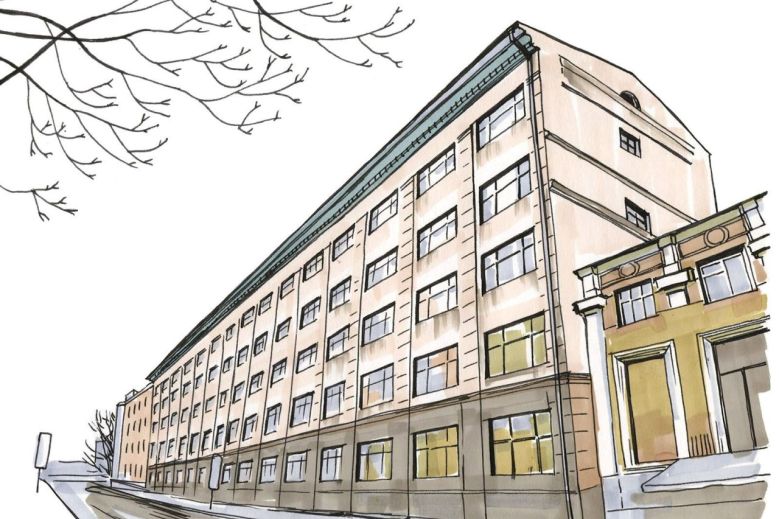
'HSE. Basis': 3 Bolshoy Tryokhsvyatitelsky Pereulok
The HSE continues the project ‘HSE. Basis’, which covers the history of the buildings the university occupies today. The second article is about Building 3 on Bolshoy Tryokhsvyatitelsky Pereulok. The main story about this place begins not in the distant time when it was owned by merchants (although it certainly was) but in the 1930s when the construction of a new institute began.
Advancing Medieval Studies in Halle
Mikhail Boytsov, Professor in the HSE’s Faculty of History, recently held the Christan Wolff professorship at the Martin Luther University in Halle and Wittenberg. He spoke with the HSE news service about his experience working in Germany and his plans for future research.
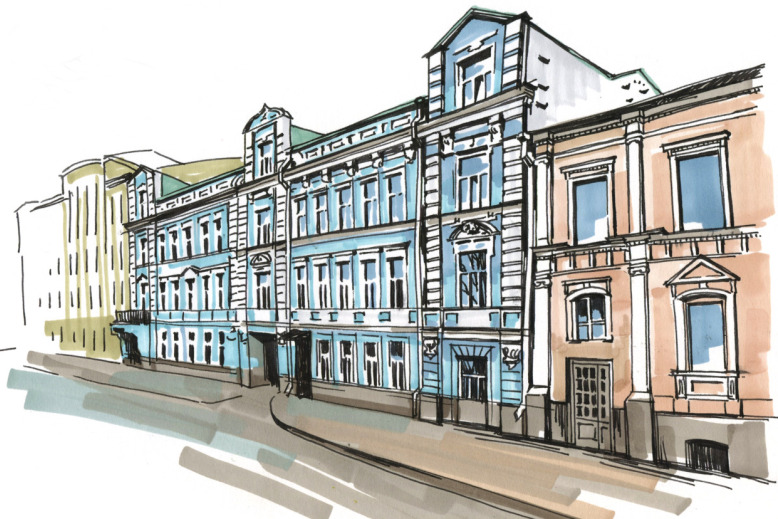
History behind HSE Buildings
The HSE launches a new project ‘HSE. Basis’, which will cover the history of the buildings the university occupies today. The first article is about number 8 Pokrovsky Boulevard which at various times has been a famous girl’s gymnasium, the apartment of the animalist painter Stepanov, and the editorial offices of the Great Soviet Encyclopedia.
HSE History Professors Win South African Book of the Year Award
South African publishing conglomerate Media 24 has awarded the book The Hidden Thread. Russia and South Africa in the Soviet Eraby Professors Irina Filatova and Apollon Davidson of HSE’s Faculty of History the Recht Malan Prize for Best Non-Fiction of the year. This is the country’s top literary award for works of nonfiction.
Anthony John Heywood on the Weather and Tsarist Russia’s War Effort
Anthony John Heywood, Chair in History at the School of Divinity, History and Philosophy, (University of Aberdeen), recently took part in the international conference ‘Russia in the First World War’, which was organized by the HSE’s International Centre for the History and Sociology of World War II and its Consequences and took place on June 3-5, 2014. He spoke with the HSE news service about his interests in weather, Russia’s railways, the study of history in today’s society, as well as his impressions of collaborating with Russian colleagues.
Alfred Rieber Speaks on Social Fragmentation at First World War Conference
Alfred J. Rieber, University Research Professor at Central European University (Budapest, Hungary), recently presented at the international conference ‘Russia in the First World War’, which was organized by the HSE’s International Centre for the History and Sociology of World War II and its Consequences and took place on June 3-5, 2014.
From Agrarian Studies to Zoos: Professor Tracy McDonald Speaks about Her Interests
Tracy McDonald is a professor of Russian and Soviet History at McMaster University in Ontario, Canada. In 2011, her first book, Face to the Village: The Riazan Countryside Under Soviet Rule was published by the University of Toronto Press in 2011. Currently she is conducting research for a book titled Behind the Iron Bars: A History of Soviet Zoos. She presented a lecture ‘Saving Beauty: Moscow and Leningrad Zoos during the Second World War’ in the HSE, Moscow and kindly agreed to answer a few questions for the HSE news service.
Constructing Usable Pasts: Why Have Interdisciplinary Approaches to History?
Julia Lajus, Associate Professor at HSE Faculty of History, Senior Researcher, Center for Historical Research, HSE St. Petersburg, Co-chair of the Master’s programme in Applied and Interdisciplinary History and Vice President of the European Society for Environmental History (ESEH), spoke to the HSE English language news Portal about the subject of a conference hosted by the Faculty of History at St. Petersburg campus on 28-29 March 'A Usable Past: Applied and Interdisciplinary History'.
Cultural Nationalism Contributed to the Fall of the Soviet Union
Nationalism in the post-Soviet republics did not arise solely as a result of the economic and political crisis in the Soviet Union. The longstanding policy of the Soviet elite aimed at forming a multinational state is what enabled it. Authorities sought to use ethnic diversity to strengthen the state structure, but the result was exactly the opposite. A study by Andrey Shcherbak, senior research fellow at the HSE’s Laboratory for Comparative Social Research (LCSR).