

How the Brain Responds to Prices: Scientists Discover Neural Marker for Price Perception

Russian scientists have discovered how the brain makes purchasing decisions. Using electroencephalography (EEG) and magnetoencephalography (MEG), researchers found that the brain responds almost instantly when a product's price deviates from expectations. This response engages brain regions involved in evaluating rewards and learning from past decisions. Thus, perceiving a product's value is not merely a conscious choice but also a function of automatic cognitive mechanisms. The results have been published in Frontiers in Human Neuroscience.
Every day, people are faced with prices of food, technology, and services. Sometimes, a product seems overpriced, while other times, it appears suspiciously cheap. Do consumers consciously judge prices, or does the brain do it automatically? Researchers from HSE University and Neurotrend, a Russian neuromarketing company, set out to investigate how the brain responds to unexpected prices.
Participants in the experiment were shown images of mobile phones (iPhone, Nokia, Xiaomi), followed by their hypothetical prices. The prices could be above, below, or matching the actual market value of the products. Afterward, the target word 'expensive' or 'cheap' appeared on the screen, and participants had to determine whether the word matched the given price. Throughout the experiment, the researchers recorded participants' brain activity using EEG and MEG, methods that track changes in brain neuron activity. A total of 65 individuals participated in the study.
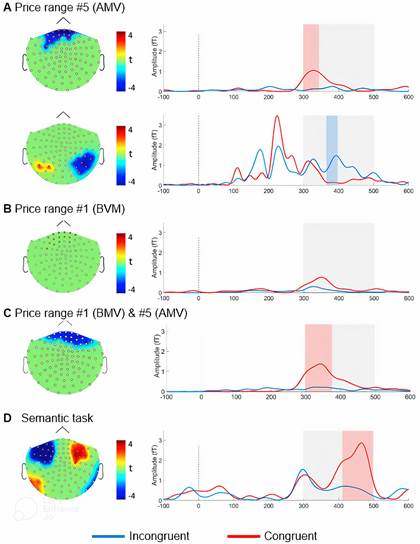
The findings reveal that perceiving prices significantly different from the actual market value triggered a strong N400 signal, an electrical impulse in the brain typically generated when confronted with unexpected information. Notably, prices perceived as excessively high triggered a stronger response than those seen as too low. The scientists explain this by suggesting that implausibly high discounts may be perceived with scepticism. Additionally, it appears that the brain's response can vary depending on the product's brand. For the Xiaomi mobile phone, the price range that triggered a strong N400 response was found to be broader. This may suggest that people did not have a clear enough understanding of the real market value of this product.

Andrew Kislov
'Back when I was in my bachelor's programme at HSE University, I wondered whether it was possible to determine from brain activity what price a person considers acceptable. Our experiments have confirmed that it is indeed possible,’ comments Andrew Kislov, doctoral student at the HSE Faculty of Social Sciences and co-author of the study. 'Globally, we are working to develop an objective method for assessing customer preferences. To what extent, in doing so, do we have the right to invade a person's inner world? This is a good question, but in this project, we simply aimed to determine the maximum price that would be comfortable for people, and this method does not pose any real threat to customers.'
To identify which regions of the brain respond to prices, the researchers analysed MEG data. They found that when perceiving 'non-optimal' prices, the frontal cortex and anterior cingulate gyrus—regions responsible for decision-making and assessing rewards—were activated.

Vasily Klucharev
'The results demonstrate that when the price does not meet expectations, the brain responds almost instantly. Moreover, the response is linked to brain regions involved in assessing rewards and learning from past decisions. This means that the perception of a product's value is part of automatic cognitive mechanisms that are activated long before an individual consciously makes a decision,' explains the chief researcher Vasily Klucharev, Head of the International Laboratory of Social Neurobiology.
The study also provides marketers with new tools: instead of relying solely on surveys, they can gain insight into consumers' perception of prices at the neurocognitive level.

Anna Shestakova
'Marketers are increasingly saying that conventional consumer surveys don't provide a complete picture, as people cannot always explain why a certain price seems too high or too low to them. People often say what they think is expected of them. Therefore, we conducted this study in collaboration with a leading neuromarketing company, Neurotrend, and discovered that it is possible to examine an individual's brain and determine whether a specific product price meets their expectations. This approach can help predict how people will perceive the price of a new product even before it is released to the market,' explains the chief researcher Anna Shestakova, Director of the HSE Institute for Cognitive Neuroscience.
See also:

Scientists Test Asymmetry Between Matter and Antimatter
An international team, including scientists from HSE University, has collected and analysed data from dozens of experiments on charm mixing—the process in which an unstable charm meson oscillates between its particle and antiparticle states. These oscillations were observed only four times per thousand decays, fully consistent with the predictions of the Standard Model. This indicates that no signs of new physics have yet been detected in these processes, and if unknown particles do exist, they are likely too heavy to be observed with current equipment. The paper has been published in Physical Review D.
HSE Scientists Reveal What Drives Public Trust in Science
Researchers at HSE ISSEK have analysed the level of trust in scientific knowledge in Russian society and the factors shaping attitudes and perceptions. It was found that trust in science depends more on everyday experience, social expectations, and the perceived promises of science than on objective knowledge. The article has been published in Universe of Russia.
Scientists Uncover Why Consumers Are Reluctant to Pay for Sugar-Free Products
Researchers at the HSE Institute for Cognitive Neuroscience have investigated how 'sugar-free' labelling affects consumers’ willingness to pay for such products. It was found that the label has little impact on the products’ appeal due to a trade-off between sweetness and healthiness: on the one hand, the label can deter consumers by implying an inferior taste, while on the other, it signals potential health benefits. The study findings have been published in Frontiers in Nutrition.
HSE Psycholinguists Launch Digital Tool to Spot Dyslexia in Children
Specialists from HSE University's Centre for Language and Brain have introduced LexiMetr, a new digital tool for diagnosing dyslexia in primary school students. This is the first standardised application in Russia that enables fast and reliable assessment of children’s reading skills to identify dyslexia or the risk of developing it. The application is available on the RuStore platform and runs on Android tablets.
Physicists Propose New Mechanism to Enhance Superconductivity with 'Quantum Glue'
A team of researchers, including scientists from HSE MIEM, has demonstrated that defects in a material can enhance, rather than hinder, superconductivity. This occurs through interaction between defective and cleaner regions, which creates a 'quantum glue'—a uniform component that binds distinct superconducting regions into a single network. Calculations confirm that this mechanism could aid in developing superconductors that operate at higher temperatures. The study has been published in Communications Physics.
Neural Network Trained to Predict Crises in Russian Stock Market
Economists from HSE University have developed a neural network model that can predict the onset of a short-term stock market crisis with over 83% accuracy, one day in advance. The model performs well even on complex, imbalanced data and incorporates not only economic indicators but also investor sentiment. The paper by Tamara Teplova, Maksim Fayzulin, and Aleksei Kurkin from the Centre for Financial Research and Data Analytics at the HSE Faculty of Economic Sciences has been published in Socio-Economic Planning Sciences.
Larger Groups of Students Use AI More Effectively in Learning
Researchers at the Institute of Education and the Faculty of Economic Sciences at HSE University have studied what factors determine the success of student group projects when they are completed with the help of artificial intelligence (AI). Their findings suggest that, in addition to the knowledge level of the team members, the size of the group also plays a significant role—the larger it is, the more efficient the process becomes. The study was published in Innovations in Education and Teaching International.
New Models for Studying Diseases: From Petri Dishes to Organs-on-a-Chip
Biologists from HSE University, in collaboration with researchers from the Kulakov National Medical Research Centre for Obstetrics, Gynecology, and Perinatology, have used advanced microfluidic technologies to study preeclampsia—one of the most dangerous pregnancy complications, posing serious risks to the life and health of both mother and child. In a paper published in BioChip Journal, the researchers review modern cellular models—including advanced placenta-on-a-chip technologies—that offer deeper insights into the mechanisms of the disorder and support the development of effective treatments.
Using Two Cryptocurrencies Enhances Volatility Forecasting
Researchers from the HSE Faculty of Economic Sciences have found that Bitcoin price volatility can be effectively predicted using Ethereum, the second-most popular cryptocurrency. Incorporating Ethereum into a predictive model reduces the forecast error to 23%, outperforming neural networks and other complex algorithms. The article has been published in Applied Econometrics.
Administrative Staff Are Crucial to University Efficiency—But Only in Teaching-Oriented Institutions
An international team of researchers, including scholars from HSE University, has analysed how the number of non-academic staff affects a university’s performance. The study found that the outcome depends on the institution’s profile: in research universities, the share of administrative and support staff has no effect on efficiency, whereas in teaching-oriented universities, there is a positive correlation. The findings have been published in Applied Economics.