

Russian Scientists Assess Dangers of Internal Waves During Underwater Volcanic Eruptions

Mathematicians at HSE University in Nizhny Novgorod and the A.V. Gaponov-Grekhov Institute of Applied Physics of the Russian Academy of Sciences studied internal waves generated in the ocean after the explosive eruption of an underwater volcano. The researchers calculated how the waves vary depending on ocean depth and the radius of the explosion source. It turns out that the strongest wave in the first group does not arrive immediately, but after a significant delay. This data can help predict the consequences of eruptions and enable advance preparation for potential threats. The article has been published in Natural Hazards. The research was carried out with support from the Russian Science Foundation (link in Russian).
Layers of water with varying temperature, density, and salinity form in an ocean column. Internal waves arise at the boundaries of these layers due to external forces such as wind, currents, earthquakes, and volcanic eruptions, which cause the upper and lower layers to shift relative to each other. The boundary starts to oscillate, attempting to return to its original position under the influence of buoyancy forces. Since the density difference between the layers is small, internal waves have a larger amplitude (usually 5–20 metres but sometimes up to 150 metres) compared to surface waves, where the density contrast between water and air is much greater.
Although the speeds of internal waves are relatively slow (typically only a few dozen centimetres per second), they can still pose a serious threat to hydraulic structures, underwater gas and oil pipelines, and can also lead to the erosion of the ocean floor. Disasters involving at least three submarines have been attributed to the effects of internal waves: the two American atomic submarines, USS Thresher in 1963 and USS Scorpion in 1968, and the Indonesian diesel submarine KRI Nanggala-402 in 2021.
‘During underwater volcanic eruptions and earthquakes, the primary danger comes from surface tsunami waves, which can have amplitudes of up to 30 meters on the coast and can be highly destructive. Internal waves are typically not considered in such cases. However, a recent article by Chinese colleagues reported for the first time the observation of internal waves during a volcanic eruption in the Tonga Archipelago in 2022. This sparked our interest in studying the characteristics of internal waves,’ explains co-author of the study Ekaterina Didenkulova, Leading Research Fellow at the International Laboratory of Dynamical Systems and Applications at HSE University in Nizhny Novgorod.
Le Mehaute’s parabolic cavern was chosen as a source of tsunami waves. This model is commonly used to calculate surface tsunami waves generated by underwater explosions, volcanic eruptions, and meteorite impacts in water. It was considered that the curves connecting points with the same seawater density (isopycnals) bend over an underwater volcano in the same way as the water surface.
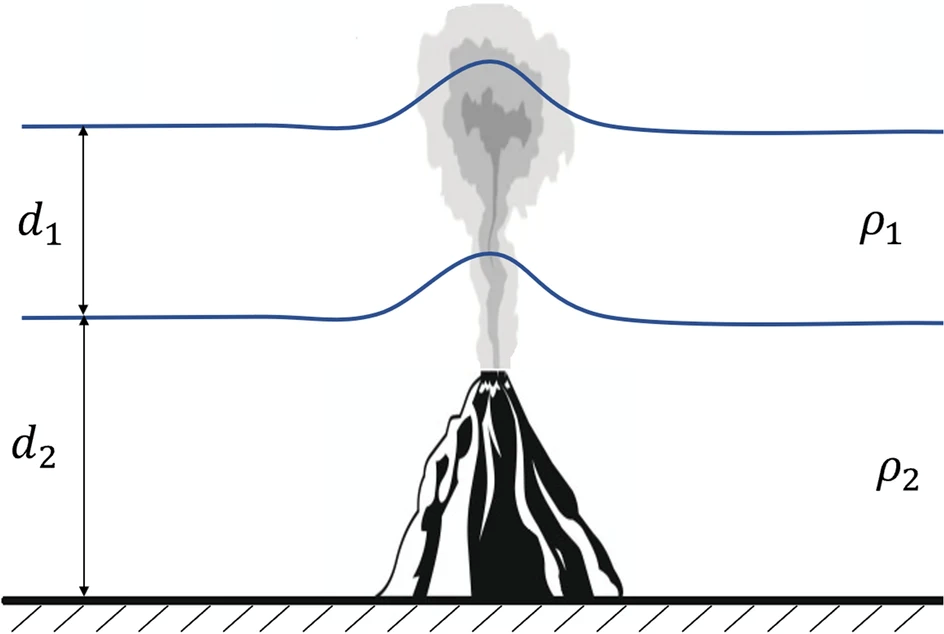
Calculations reveal that internal waves generated by the eruption of an underwater volcano form frequency-modulated groups, with the first group exhibiting the largest amplitude. The characteristics of internal waves depend on the ratio of layer thicknesses, the source radius, and the distance from the source. Even at relatively small distances from the source, the wave amplitudes change gradually, allowing the source of a tsunami to be identified from internal waves using remote sensing of the sea surface. This approach makes it possible to obtain additional information about the tsunami and mitigate potential damage caused by the disaster.

'The amplitudes of the waves in the remote zone are a percentage of their height at the source, but when translated into real numbers, they can correspond to several metres. Thus, the eruption site of the Krakatoa volcano in 1883 had a height of 200 metres and a radius of three kilometres. Our calculations indicate that the height of an internal wave at a distance of 300 kilometres can be around 10 meters, which could still pose a danger,' comments Efim Pelinovsky, Chief Research Fellow at the International Laboratory of Dynamical Systems and Applications at HSE University in Nizhny Novgorod.
See also:

Scientists Test Asymmetry Between Matter and Antimatter
An international team, including scientists from HSE University, has collected and analysed data from dozens of experiments on charm mixing—the process in which an unstable charm meson oscillates between its particle and antiparticle states. These oscillations were observed only four times per thousand decays, fully consistent with the predictions of the Standard Model. This indicates that no signs of new physics have yet been detected in these processes, and if unknown particles do exist, they are likely too heavy to be observed with current equipment. The paper has been published in Physical Review D.
HSE Scientists Reveal What Drives Public Trust in Science
Researchers at HSE ISSEK have analysed the level of trust in scientific knowledge in Russian society and the factors shaping attitudes and perceptions. It was found that trust in science depends more on everyday experience, social expectations, and the perceived promises of science than on objective knowledge. The article has been published in Universe of Russia.
Scientists Uncover Why Consumers Are Reluctant to Pay for Sugar-Free Products
Researchers at the HSE Institute for Cognitive Neuroscience have investigated how 'sugar-free' labelling affects consumers’ willingness to pay for such products. It was found that the label has little impact on the products’ appeal due to a trade-off between sweetness and healthiness: on the one hand, the label can deter consumers by implying an inferior taste, while on the other, it signals potential health benefits. The study findings have been published in Frontiers in Nutrition.
HSE Psycholinguists Launch Digital Tool to Spot Dyslexia in Children
Specialists from HSE University's Centre for Language and Brain have introduced LexiMetr, a new digital tool for diagnosing dyslexia in primary school students. This is the first standardised application in Russia that enables fast and reliable assessment of children’s reading skills to identify dyslexia or the risk of developing it. The application is available on the RuStore platform and runs on Android tablets.
Physicists Propose New Mechanism to Enhance Superconductivity with 'Quantum Glue'
A team of researchers, including scientists from HSE MIEM, has demonstrated that defects in a material can enhance, rather than hinder, superconductivity. This occurs through interaction between defective and cleaner regions, which creates a 'quantum glue'—a uniform component that binds distinct superconducting regions into a single network. Calculations confirm that this mechanism could aid in developing superconductors that operate at higher temperatures. The study has been published in Communications Physics.
Neural Network Trained to Predict Crises in Russian Stock Market
Economists from HSE University have developed a neural network model that can predict the onset of a short-term stock market crisis with over 83% accuracy, one day in advance. The model performs well even on complex, imbalanced data and incorporates not only economic indicators but also investor sentiment. The paper by Tamara Teplova, Maksim Fayzulin, and Aleksei Kurkin from the Centre for Financial Research and Data Analytics at the HSE Faculty of Economic Sciences has been published in Socio-Economic Planning Sciences.
Larger Groups of Students Use AI More Effectively in Learning
Researchers at the Institute of Education and the Faculty of Economic Sciences at HSE University have studied what factors determine the success of student group projects when they are completed with the help of artificial intelligence (AI). Their findings suggest that, in addition to the knowledge level of the team members, the size of the group also plays a significant role—the larger it is, the more efficient the process becomes. The study was published in Innovations in Education and Teaching International.
New Models for Studying Diseases: From Petri Dishes to Organs-on-a-Chip
Biologists from HSE University, in collaboration with researchers from the Kulakov National Medical Research Centre for Obstetrics, Gynecology, and Perinatology, have used advanced microfluidic technologies to study preeclampsia—one of the most dangerous pregnancy complications, posing serious risks to the life and health of both mother and child. In a paper published in BioChip Journal, the researchers review modern cellular models—including advanced placenta-on-a-chip technologies—that offer deeper insights into the mechanisms of the disorder and support the development of effective treatments.
Using Two Cryptocurrencies Enhances Volatility Forecasting
Researchers from the HSE Faculty of Economic Sciences have found that Bitcoin price volatility can be effectively predicted using Ethereum, the second-most popular cryptocurrency. Incorporating Ethereum into a predictive model reduces the forecast error to 23%, outperforming neural networks and other complex algorithms. The article has been published in Applied Econometrics.
Administrative Staff Are Crucial to University Efficiency—But Only in Teaching-Oriented Institutions
An international team of researchers, including scholars from HSE University, has analysed how the number of non-academic staff affects a university’s performance. The study found that the outcome depends on the institution’s profile: in research universities, the share of administrative and support staff has no effect on efficiency, whereas in teaching-oriented universities, there is a positive correlation. The findings have been published in Applied Economics.