

HSE and Tsinghua University Strengthen Russia–China Partnership as part of Cross Year of Education

On May 10, a delegation from Tsinghua University—one of China’s leading higher education institutions—paid an official visit to HSE University. The delegation was led by Qiu Yong, Secretary of the CPC Tsinghua University Committee, former President and Chair of the University Council, and member of the Chinese Academy of Sciences.
The visit followed major intergovernmental agreements signed on May 8, 2025, in Moscow by Russian President Vladimir Putin and Chinese President Xi Jinping. Among these was the initiative to hold a Cross Year of Education in both Russia and China aimed at deepening humanitarian and academic ties. Both sides emphasised the importance of mutual learning and the exchange of best practices in higher education.

Ahead of the meeting, HSE University signed cooperation agreements with two of China’s top universities—Peking University and Tsinghua University. The agreement with Tsinghua focuses on developing academic, cultural, scientific, and educational ties, including joint projects and student exchanges. The signing took place at the Kremlin in the presence of both heads of state and was part of the official programme marking the 80th anniversary of Victory Day.
During the visit to HSE University, the two sides discussed concrete steps to strengthen their partnership. Priority areas included the launch of joint technology and research projects, the implementation of double degree programmes, the creation of a joint postgraduate school in artificial intelligence and education sciences, and the organisation of a summer school in Moscow for Tsinghua students. Particular attention was paid to the transformation of postgraduate education in both countries as a key element of mutual learning under the Cross Year of Education.

Nikita Anisimov
HSE Rector Nikita Anisimov highlighted that China is currently a world leader in scientific activity, including in fields such as chemistry, computer science, engineering, materials science, and mathematics. He also noted that HSE University holds leading positions in Russia in terms of the quality of its educational programmes, entry exam scores, and graduate employability.
According to the rector, cooperation with Tsinghua University is not only an exchange of knowledge but also an opportunity to enrich the academic environment. In turn, Qiu Yong praised the educational practices of HSE University.
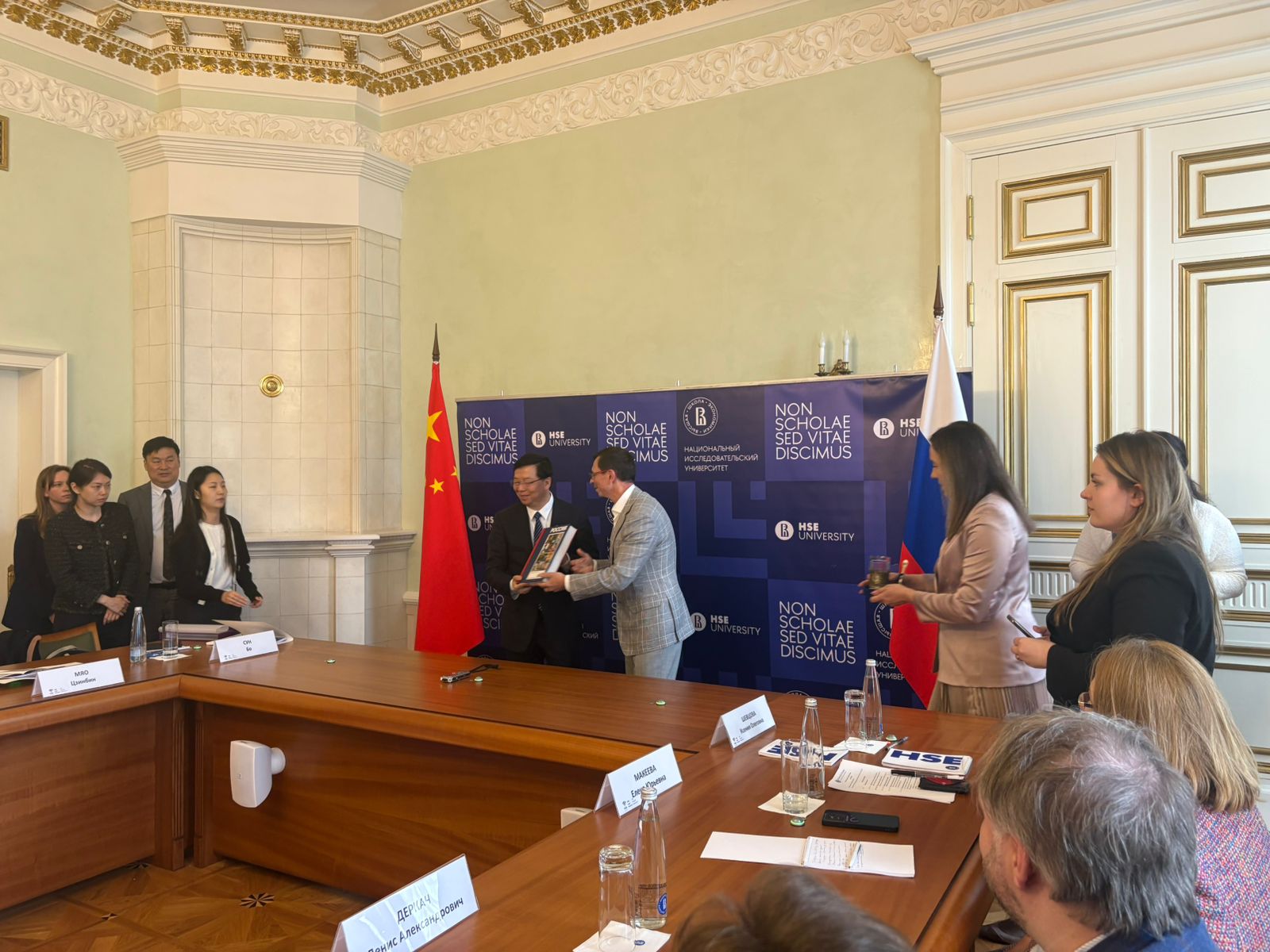
The discussions also touched upon organising a summer school on Russian language and culture in Moscow for Tsinghua students and teachers, as well as the development of a joint educational programme in Russian literature—another step toward mutual cultural and academic exchange.
The Chinese delegation expressed appreciation for the HSE visit to Tsinghua in March 2025 and confirmed its interest in further developing cooperation. They showed particular interest in HSE's practices, which, according to Tsinghua representatives, are seen in China as exemplary and worthy of study.
In addition, the delegation expressed readiness to collaborate on addressing global scientific challenges, including the development of artificial intelligence and digital technologies. Special attention was also given to cooperation within the BRICS framework. Participants noted that this visit marks only the beginning of a long-term dialogue and expressed hope for its continuation.
HSE’s cooperation with leading Chinese universities spans a wide range of fields—from engineering and natural sciences to humanities and education policy. Deepening the partnership with Tsinghua is seen as a strategic step within the Cross Year of Education and the broader strengthening of the Russia–China academic dialogue.
See also:

Scientists Discover That the Brain Responds to Others’ Actions as if They Were Its Own
When we watch someone move their finger, our brain doesn’t remain passive. Research conducted by scientists from HSE University and Lausanne University Hospital shows that observing movement activates the motor cortex as if we were performing the action ourselves—while simultaneously ‘silencing’ unnecessary muscles. The findings were published in Scientific Reports.
HSE Scientists Reveal What Drives Public Trust in Science
Researchers at HSE ISSEK have analysed the level of trust in scientific knowledge in Russian society and the factors shaping attitudes and perceptions. It was found that trust in science depends more on everyday experience, social expectations, and the perceived promises of science than on objective knowledge. The article has been published in Universe of Russia.
IDLab: Fascinating Research, Tough Deadlines, and Academic Drive
The International Laboratory of Intangible-driven Economy (IDLab) was established at the HSE campus in Perm 11 years ago. Its expertise in data processing and analysis allows researchers to combine fundamental studies with applied projects, including the development of risk and cybersecurity models for Sber. The head of the laboratory, Professor Petr Parshakov, and Senior Research Fellow Professor Mariya Molodchik spoke to the HSE News Service about IDLab’s work.
HSE Lecturers Awarded Yandex ML Prize 2025
The Yandex ML Prize is awarded to lecturers and heads of educational programmes who contribute to the development of artificial intelligence in Russia. This year, 10 laureates were selected from 300 applicants, including three members of the HSE Faculty of Computer Science (FCS). A special Hall of Fame award was also presented for contributions to the establishment of machine learning as an academic field. One of the recipients was Dmitry Vetrov, Research Professor at the HSE FCS.
Eighth International U4U Online Seminar Unites Experts from 14 Countries
The HSE Online Campus hosted a two-day international U4U (Universities for Universities) seminar, which traditionally serves as a platform for exchanging expertise in online learning. This year, the event has reached a global scale, attracting international experts and representatives of universities from around the world. Together, they discussed key challenges and strategies for the development of online education. The online meeting was held in mid-November.
HSE Tops Ranking of Universities Participating in Priority 2030 Programme
The Russian Ministry of Science and Higher Education has published an updated list of participants in the Priority 2030 programme. A total of 106 universities will receive support this year. HSE University was included in the first group and topped the ranking.
‘Keep Working, Keep Publishing—Consistency Matters’
Ziyuan Zhu, from Beijing, China, is an international PhD student at the Institute for Public Administration and Governance at HSE University in Moscow. In this interview with the HSE News Service, Ziyuan talks about how studies can influence one’s outlook on life, comparing public service models in different countries, and why being a Chinese student in Russia is advantageous in research.
HSE University and Banking and Finance Academy of Uzbekistan Sign Memorandum on Scientific Cooperation
The partnership aims to foster academic collaboration in the fields of global economics, sustainable development, and Islamic finance. Strengthening academic ties with Uzbekistan represents a promising direction for scientific exchanges and the implementation of international projects in sustainable development.
HSE Scientists Optimise Training of Generative Flow Networks
Researchers at the HSE Faculty of Computer Science have optimised the training method for generative flow neural networks to handle unstructured tasks, which could make the search for new drugs more efficient. The results of their work were presented at ICLR 2025, one of the world’s leading conferences on machine learning. The paper is available at Arxiv.org.
Under a Blooming Magnolia: How Russian and Chinese Scientists Create Solar Cells of the Future
Schola continues to introduce the winners of the International Academic Cooperation competition. In today's issue, Professor Andrey Vasenko, Deputy Head of the Scientific and Educational Laboratory of Quantum Nanoelectronics at Tikhonov Moscow Institute of Electronics and Mathematics (MIEM), speaks about the joint project between his laboratory and the Peking University research team— ‘Engineering of highly efficient and stable perovskite solar cells.’