

HSE and Tsinghua University Strengthen Russia–China Partnership as part of Cross Year of Education

On May 10, a delegation from Tsinghua University—one of China’s leading higher education institutions—paid an official visit to HSE University. The delegation was led by Qiu Yong, Secretary of the CPC Tsinghua University Committee, former President and Chair of the University Council, and member of the Chinese Academy of Sciences.
The visit followed major intergovernmental agreements signed on May 8, 2025, in Moscow by Russian President Vladimir Putin and Chinese President Xi Jinping. Among these was the initiative to hold a Cross Year of Education in both Russia and China aimed at deepening humanitarian and academic ties. Both sides emphasised the importance of mutual learning and the exchange of best practices in higher education.

Ahead of the meeting, HSE University signed cooperation agreements with two of China’s top universities—Peking University and Tsinghua University. The agreement with Tsinghua focuses on developing academic, cultural, scientific, and educational ties, including joint projects and student exchanges. The signing took place at the Kremlin in the presence of both heads of state and was part of the official programme marking the 80th anniversary of Victory Day.
During the visit to HSE University, the two sides discussed concrete steps to strengthen their partnership. Priority areas included the launch of joint technology and research projects, the implementation of double degree programmes, the creation of a joint postgraduate school in artificial intelligence and education sciences, and the organisation of a summer school in Moscow for Tsinghua students. Particular attention was paid to the transformation of postgraduate education in both countries as a key element of mutual learning under the Cross Year of Education.

Nikita Anisimov
HSE Rector Nikita Anisimov highlighted that China is currently a world leader in scientific activity, including in fields such as chemistry, computer science, engineering, materials science, and mathematics. He also noted that HSE University holds leading positions in Russia in terms of the quality of its educational programmes, entry exam scores, and graduate employability.
According to the rector, cooperation with Tsinghua University is not only an exchange of knowledge but also an opportunity to enrich the academic environment. In turn, Qiu Yong praised the educational practices of HSE University.
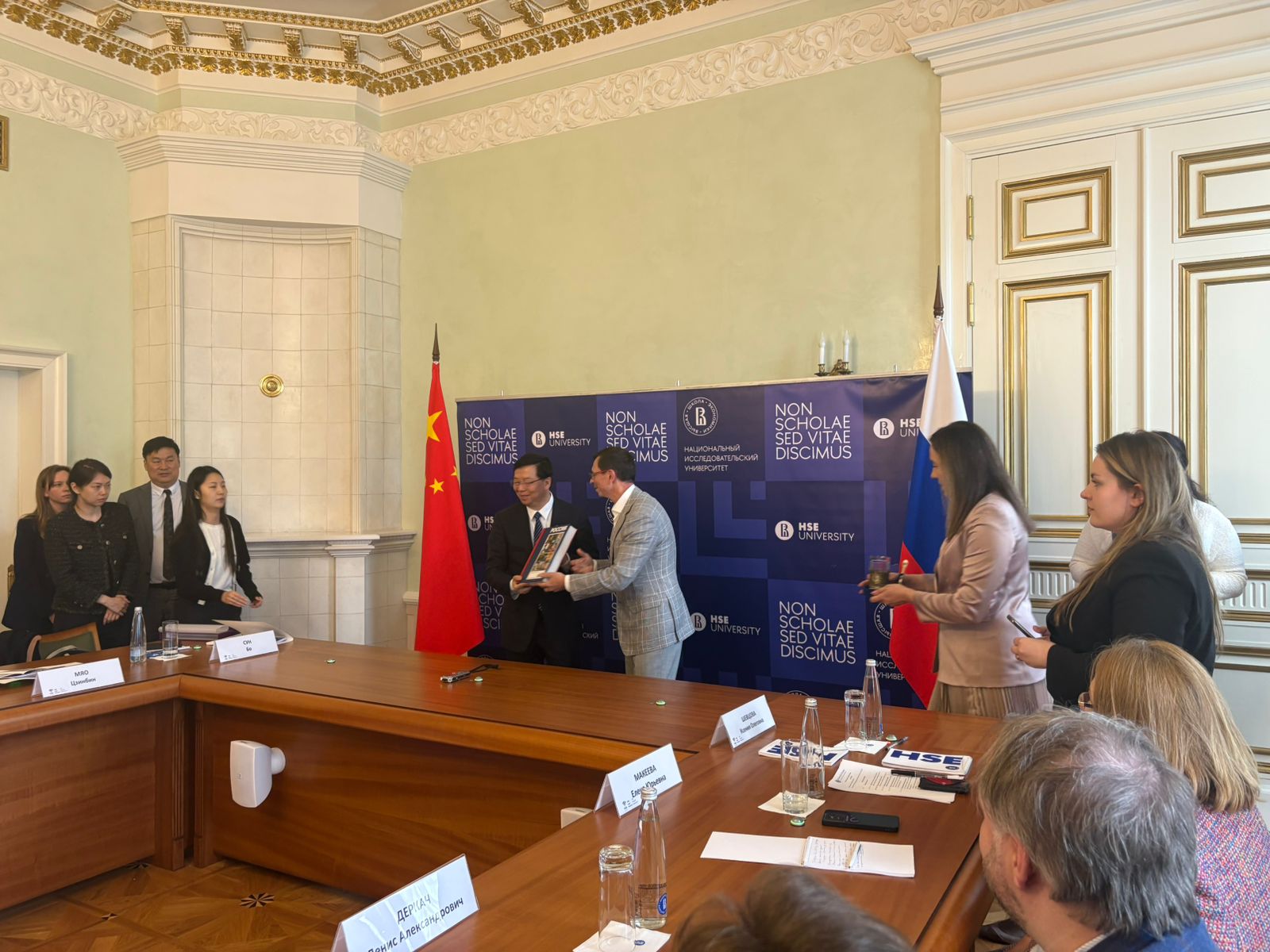
The discussions also touched upon organising a summer school on Russian language and culture in Moscow for Tsinghua students and teachers, as well as the development of a joint educational programme in Russian literature—another step toward mutual cultural and academic exchange.
The Chinese delegation expressed appreciation for the HSE visit to Tsinghua in March 2025 and confirmed its interest in further developing cooperation. They showed particular interest in HSE's practices, which, according to Tsinghua representatives, are seen in China as exemplary and worthy of study.
In addition, the delegation expressed readiness to collaborate on addressing global scientific challenges, including the development of artificial intelligence and digital technologies. Special attention was also given to cooperation within the BRICS framework. Participants noted that this visit marks only the beginning of a long-term dialogue and expressed hope for its continuation.
HSE’s cooperation with leading Chinese universities spans a wide range of fields—from engineering and natural sciences to humanities and education policy. Deepening the partnership with Tsinghua is seen as a strategic step within the Cross Year of Education and the broader strengthening of the Russia–China academic dialogue.

See also:

HSE Graduate School of Business and Alfa-Bank Hold Summer School for Students from China
Twenty-seven students from Chinese universities took part in the international summer school ‘Digital Product Management’ organised by the HSE Graduate School of Business and Alfa-Bank. Over the course of a week, participants explored the Russian economy and business environment, learned about current technology trends, and worked through the key stages of digital product development step by step—from researching user needs and defining a problem to developing a prototype and presenting their final project.
Physicists Discover What Happens Inside a Stable Vortex
Large vortices with characteristic spiral arms are often observed in the atmosphere and the ocean. Physicists from HSE University have explained how these structures form and why they retain their shape. The researchers found that velocities at points located along the same vortex arc remain correlated even over long distances. At the same time, this correlation weakens rapidly with increasing distance from the vortex centre. These differences help explain the formation of spiral arms and may improve models of atmospheric and oceanic currents. The findings have been published in Physical Review Fluids.
‘The Peak of Stupidity’ and ‘The Valley of Despair’: HSE Economists Propose an Explanation for the Dunning–Kruger Effect
The Dunning–Kruger effect, which describes a sharp surge in self-confidence among beginners followed by an equally rapid decline as they gain experience, can be explained by the nature of the learning process and the acquisition of new knowledge. This conclusion was reached by Andrey Vorchik of the HSE Faculty of Economic Sciences together with independent researcher Murat Mamyshev. They developed a mathematical model of learning and demonstrated how subjective confidence is formed and changes as knowledge accumulates, as well as how teachers can reduce the ‘valley of despair’ experienced by learners.
Advancing Collaboration: HSE Faculty of Computer Science and Harbin Institute of Technology Hold Joint Seminar
From July 13 to 16, 2026, the Faculty of Computer Science hosted the Russian–Sino Research Seminar on Machine Learning Applications, organised by the HSE Laboratory for Cloud and Mobile Technologies in partnership with the Harbin Institute of Technology (China). A delegation comprising seven students and three university representatives travelled to Moscow to take part in an intensive four-day programme.
‘There’s a Big Practical Component in My Programme—That’s Especially Important in This Field’
Zou Jiaxu moved to Moscow from Heihe, China, at a young age. Having finished high school in Moscow, she decided to enrol in the Bachelor’s in Media Communications at the Institute of Media of the HSE Faculty of Creative Industries. Now in her second year of studies, Zou talked to the HSE News Service about the opportunities for practical experience available to HSE students, her volunteering and extracurricular activities, why learning Russian is a never-ending process, and the importance of making friends wherever you go.
HSE and Karakalpak State University Agree on Cooperation
HSE University and Berdakh Karakalpak State University have signed a cooperation agreement to strengthen collaboration in research, education, and innovation. Through the expertise of its Сentre of Digital Technologies for Nature-Based Solutions of the Carbon Measurement Supersites Programme, HSE University will work with colleagues from Uzbekistan to assess climate risks and evaluate opportunities for implementing nature-based climate projects in the region. The partners also plan to develop joint research and educational programmes.
International Dialogue and New Approaches: Highlights from Fudan University’s Summer School
At the beginning of July 2026, students from the HSE Faculty of World Economy and International Affairs took part in the Summer School on International Relations organised by Fudan University (China), one of the leading international educational programmes in this field. Over the course of two weeks, they explored contemporary approaches to global governance and the development of the Global South, attended lectures by renowned scholars from around the world, and discussed current international issues with fellow students from across the globe.
‘We Are Always Open to Collaboration, and China Is One of Our Most Important Partners’
From July 20 to 27, 2026, the HSE Faculty of Urban and Regional Development (FURD) is hosting a summer school for students from Tianjin University dedicated to the preservation of cultural heritage. Throughout the week, participants have attended lectures, practical workshops, and field visits to some of Moscow’s most iconic heritage sites. The summer school is the faculty’s first international programme of this kind and forms part of the expanding educational cooperation between Russia and China.
Physicists at HSE University and FIAN Discover Way to 'Photograph' Sound for Testing Materials Used in 6G Communications
Researchers at HSE University, in collaboration with colleagues from the Lebedev Physical Institute of the Russian Academy of Sciences (FIAN), have developed a method for rapidly determining how firmly a film is bonded to a substrate. This is important for the creation of ultrahigh-frequency acoustic filters, which are key components of next-generation 5G and 6G communications. For the first time, researchers have succeeded in measuring the lateral rigidity of the bond between a two-dimensional material film and a substrate in this way. The study results have been published in Applied Physics Letters.
HSE University and Peking University Expand Their Partnership
Peking University President Gao Song paid his first visit to HSE University as part of his first overseas trip since taking office in May 2026. The main purpose of the talks was to consolidate existing areas of cooperation and expand joint projects between HSE University and Peking University within the framework of the Cross Years of Russia–China Cooperation in Education (2026–2027).