

.jpg "Scientists Discover That the Brain Responds to Others’ Actions as if They Were Its Own")
Scientists Discover That the Brain Responds to Others’ Actions as if They Were Its Own
When we watch someone move their finger, our brain doesn’t remain passive. Research conducted by scientists from HSE University and Lausanne University Hospital shows that observing movement activates the motor cortex as if we were performing the action ourselves—while simultaneously ‘silencing’ unnecessary muscles. The findings were published in Scientific Reports.

Cinema as Cultural Brand: HSE Art and Design School, École Intuit.lab, and CAFA Competition
The HSE Art and Design School, together with the French design school École intuit.lab and the Central Academy of Fine Arts in Beijing, has launched the international competition Culture Mirror—a project in which students from Russia, France, China, India, and Brazil explore iconic films from other countries and create contemporary visual and communication brands inspired by them. Submissions are open until January 15, 2026.

Russian Scientists Investigate Age-Related Differences in Brain Damage Volume Following Childhood Stroke
A team of Russian scientists and clinicians, including Sofya Kulikova from HSE University in Perm, compared the extent and characteristics of brain damage in children who experienced a stroke either within the first four weeks of life or before the age of two. The researchers found that the younger the child, the more extensive the brain damage—particularly in the frontal and parietal lobes, which are responsible for movement, language, and thinking. The study, published in Neuroscience and Behavioral Physiology, provides insights into how age can influence the nature and extent of brain lesions and lays the groundwork for developing personalised rehabilitation programmes for children who experience a stroke early in life.

'At the Intersection of Mathematics, Biology, and Machine Learning, I Found My Place'
Aleksei Shmelev conducts research in genomics and uses machine learning to explore the history of human populations. In this interview with the HSE Young Scientists project, he discusses the adaptive introgression of Tibetans and Denisovans and the use of IBD graphs to predict human population membership.

Scientists Test Asymmetry Between Matter and Antimatter
An international team, including scientists from HSE University, has collected and analysed data from dozens of experiments on charm mixing—the process in which an unstable charm meson oscillates between its particle and antiparticle states. These oscillations were observed only four times per thousand decays, fully consistent with the predictions of the Standard Model. This indicates that no signs of new physics have yet been detected in these processes, and if unknown particles do exist, they are likely too heavy to be observed with current equipment. The paper has been published in Physical Review D.

HSE Scientists Reveal What Drives Public Trust in Science
Researchers at HSE ISSEK have analysed the level of trust in scientific knowledge in Russian society and the factors shaping attitudes and perceptions. It was found that trust in science depends more on everyday experience, social expectations, and the perceived promises of science than on objective knowledge. The article has been published in Universe of Russia.
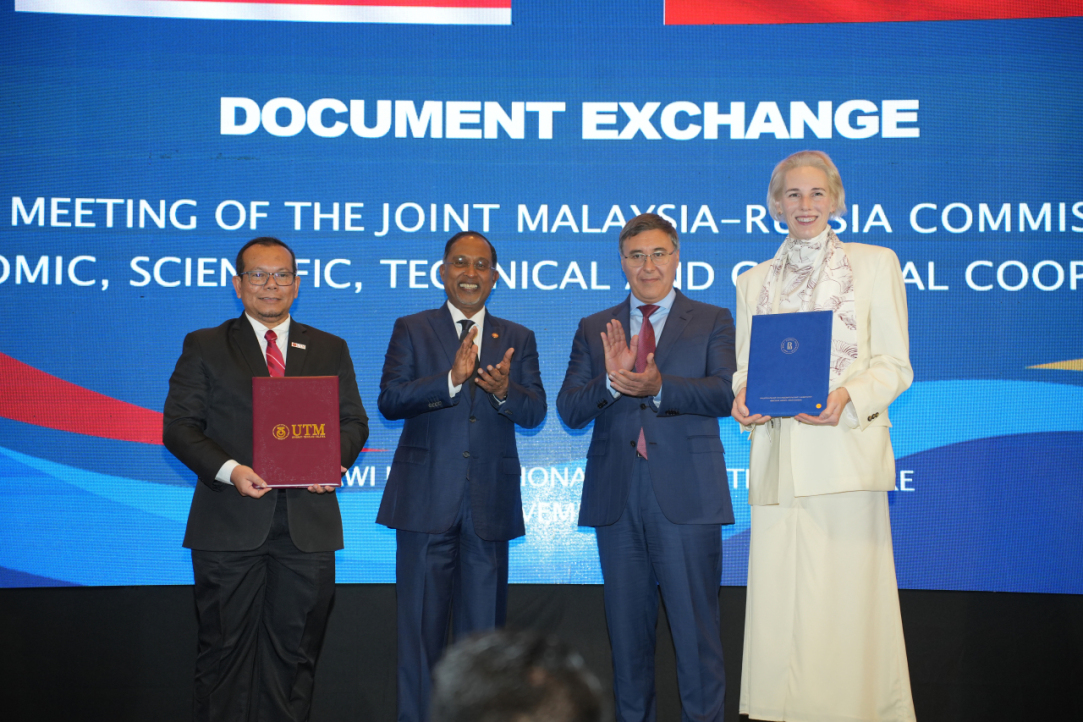
HSE and UTM Present Results of Mirror Laboratory's Work at Russian–Malaysian Commission
HSE University–St Petersburg and the Universiti Teknologi Malaysia (UTM) presented the results of two years of work and a development roadmap for the mirror laboratory on social entrepreneurship. The document outlines the strategy for global transformation in the business and digital innovation sphere.

Institute for Robotics Systems Established at HSE University
As decided by the HSE University Academic Council, a new Institute for Robotics Systems will be established at HSE, and with a strong fundamental base. It will cooperate with relevant departments across the university and engage students and doctoral candidates in research and development (R&D). First Vice Rector of HSE University and Director of the Institute for Statistical Studies and Economics of Knowledge, Leonid Gokhberg, discussed the expected practical results and the framework for cooperation with an industrial partner.

HSE University–Nizhny Novgorod Students Win GORKYCODE City Hackathon
This was the second hackathon organised by the Analytical Centre of Nizhny Novgorod and the city’s Digital Transformation Department. Eighteen student teams from the city's major higher education institutions participated, spending 52 hours developing innovative, AI-powered digital products designed to benefit Nizhny Novgorod and its residents.

Scientists Uncover Why Consumers Are Reluctant to Pay for Sugar-Free Products
Researchers at the HSE Institute for Cognitive Neuroscience have investigated how 'sugar-free' labelling affects consumers’ willingness to pay for such products. It was found that the label has little impact on the products’ appeal due to a trade-off between sweetness and healthiness: on the one hand, the label can deter consumers by implying an inferior taste, while on the other, it signals potential health benefits. The study findings have been published in Frontiers in Nutrition.