

Biologists at HSE University Warn of Potential Errors in MicroRNA Overexpression Method
Researchers at HSE University and the RAS Institute of Bioorganic Chemistry have discovered that a common method of studying genes, which relies on the overexpression of microRNAs, can produce inaccurate results. This method is widely used in the study of various pathologies, in particular cancers. Errors in experiments can lead to incorrect conclusions, affecting the diagnosis and treatment of the disease. The study findings have been published in BBA.
The work of a researcher involves not only continuous pursuit of new discoveries but also careful attention to conventional, established knowledge. Sometimes, reliable and seemingly proven methods have characteristics that were previously overlooked.
A group of researchers led by Alexander Tonevitsky, Dean of the Faculty of Biology and Biotechnology at HSE University, have discovered such characteristics in the microRNA overexpression method. The scientists found that, in some cases, the results of experiments using this method may be incorrect, and these errors are very difficult to detect.
MicroRNAs (miRNAs) are small RNA molecules, approximately 20 to 25 nucleotides in length. They play an important role in regulating gene expression by determining how much protein will be synthesised in a cell from a specific molecule of messenger RNA (mRNA). This regulation is facilitated by a short fragment within the miRNA, which can bind to the target mRNA molecule if it finds a reverse complement (biologically compatible) sequence. When this occurs, protein synthesis from the mRNA is halted, leading to a decrease in gene expression.
As diseases, including cancers, progress, changes in microRNA expression levels are observed. Specifically, in prostate cancer, the number of miR-93-5p microRNAs increases, and higher levels of their expression are associated with greater aggressiveness of the disease. By significantly increasing the number of miRNA in laboratory cells, researchers can gain a clearer understanding of the processes associated with elevated expression of this miRNA.
A common approach for miRNA overexpression involves initially increasing the amount of precursor RNA in cells—a longer molecule from which miRNA is subsequently generated through cleavage by the Dicer enzyme. This is a natural process for the cell. However, the sequence of miRNAs formed as a result depends on how accurately the Dicer enzyme cleaves the precursor molecule.
The authors of the paper studied how the Dicer enzyme cleaves the molecule. They encoded the desired sequence in the precursor molecule, anticipating that Dicer would accurately cleave it as intended. However, it turned out that Dicer does not always operate as scientists expect. The enzyme primarily functions like a molecular ruler, consistently measuring a length of 22 nucleotides. During the synthesis of the precursor molecule, one or more uracils (a nucleotide base unique to RNA) are typically added to the end of the sequence. As a result, if a given miRNA sequence is longer than 19 nucleotides, the added uracils cause Dicer to cleave the molecule at an unintended location. This shift leads to the formation of miRNA isoforms.
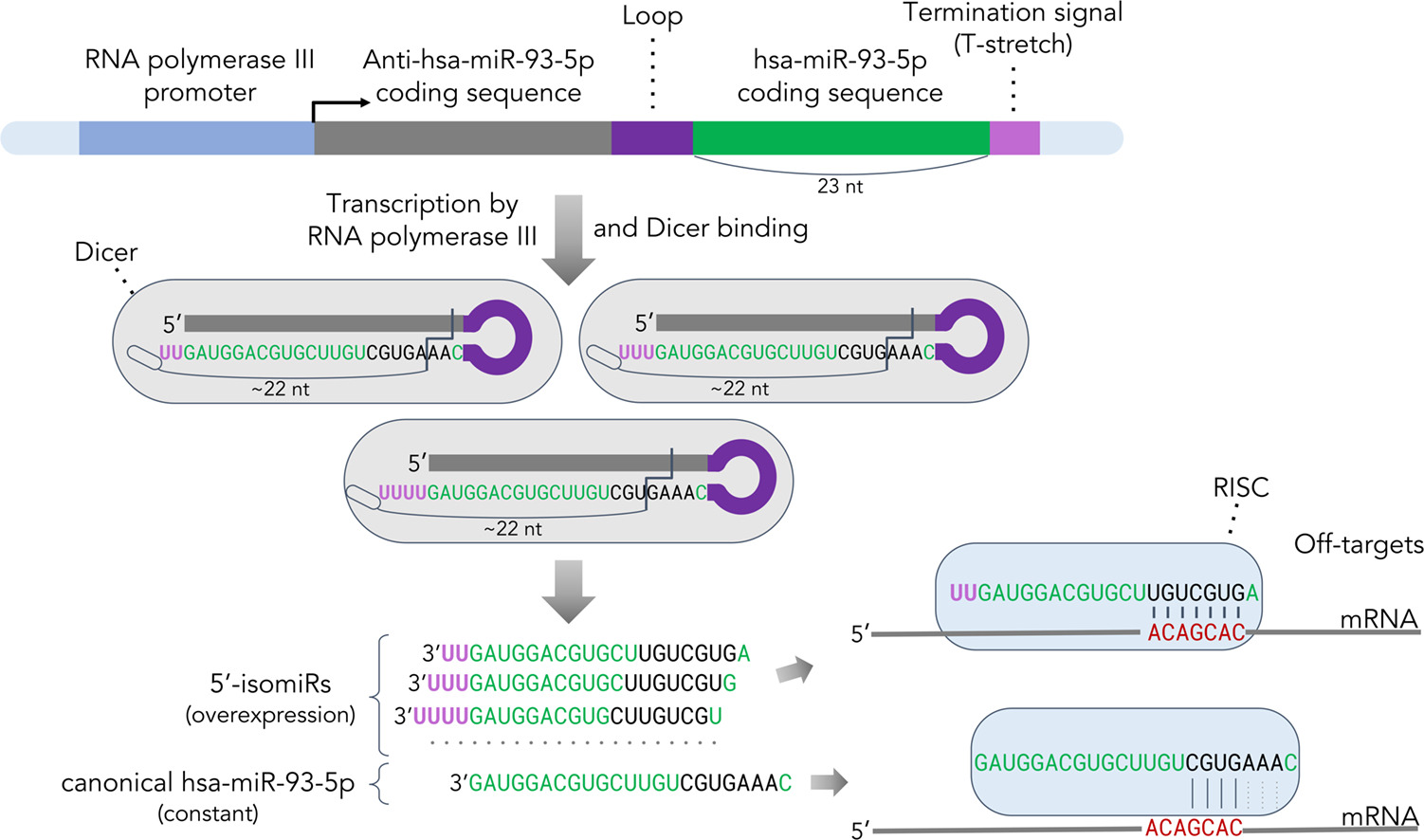
To investigate the cause of the shift in cleavage position of the precursor molecule, the scientists experimentally set several miRNA sequences of varying lengths, including a 23-nucleotide chain corresponding to the miR-93-5p miRNA. Using sequencing—a method that fully deciphers the nucleotide sequence of RNA or DNA molecules—the scientists observed that the added uracils in chains longer than 19 nucleotides cause a shift in the cleavage position.

Diana Maltseva
The formation of miR-93-5p miRNA isoforms resulted in a decrease in the expression of the HMGA1 gene, which plays a role in disrupting genetic information transmission during cell division and in regulating gene expression. However, HMGA1 was not the target of the standard form of miR-93-5p. Without knowledge of miRNA isoform formation, one might draw incorrect conclusions about the molecular mechanisms of the studied miRNA in prostate cancer.
'Isoforms may target the wrong mRNA molecules instead of those intended in the experiment, leading to the suppression of unintended genes. Understanding this peculiarity is crucial for both basic research and medical applications,' according to Diana Maltseva, Head of the International Laboratory of Microphysiological Systems at HSE University.
Scientists worldwide use the miRNA overexpression method in their experiments. Typically, the accuracy of the results is verified using polymerase chain reaction (PCR). However, this method was not sufficiently sensitive in this case.
'Our study has shown that only sequencing can reveal the shift in the cleavage position. Unfortunately, sequencing is a relatively expensive method, and not all laboratories can afford it. Therefore, it is crucial to develop new methods for miRNA overexpression and to design experiments carefully,' Maltseva comments.
See also:

New Clustering Method Simplifies Analysis of Large Data Sets
Researchers from HSE University and the Institute of Control Sciences of the Russian Academy of Sciences have proposed a new method of data analysis: tunnel clustering. It allows for the rapid identification of groups of similar objects and requires fewer computational resources than traditional methods. Depending on the data configuration, the algorithm can operate dozens of times faster than its counterparts. Thestudy was published in the journal Doklady Rossijskoj Akademii Nauk. Mathematika, Informatika, Processy Upravlenia.
Researchers from HSE University in Perm Teach AI to Analyse Figure Skating
Researchers from HSE University in Perm have developed NeuroSkate, a neural network that identifies the movements of skaters on video and determines the correctness of the elements performed. The algorithm has already demonstrated success with the basic elements, and further development of the model will improve its accuracy in identifying complex jumps.
Script Differences Hinder Language Switching in Bilinguals
Researchers at the HSE Centre for Language and Brain used eye-tracking to examine how bilinguals switch between languages in response to context shifts. Script differences were found to slow down this process. When letters appear unfamiliar—such as the Latin alphabet in a Russian-language text—the brain does not immediately switch to the other language, even when the person is aware they are in a bilingual setting. The article has been published in Bilingualism: Language and Cognition.
HSE Experts Highlight Factors Influencing EV Market Growth
According to estimates from HSE University, Moscow leads in the number of charging stations for electric vehicles in Russia, while Nizhny Novgorod ranks first in terms of charging station coverage, with 11.23 electric vehicles per charging station, compared to 14.41 in Moscow. The lack of charging infrastructure is one of the key factors limiting the growth of the electric vehicle market. This is stated in the study titled ‘Socio-Economic Aspects of Introducing Electric Vehicles in Commercial Transportation’ conducted by experts from the Institute of Transport Economics and Transport Policy Studies at HSE University.
Machine Learning Links Two New Genes to Ischemic Stroke
A team of scientists from HSE University and the Kurchatov Institute used machine learning methods to investigate genetic predisposition to stroke. Their analysis of the genomes of over 5,000 people identified 131 genes linked to the risk of ischemic stroke. For two of these genes, the association was found for the first time. The paper has been published in PeerJ Computer Science.
First Digital Adult Reading Test Available on RuStore
HSE University's Centre for Language and Brain has developed the first standardised tool for assessing Russian reading skills in adults—the LexiMetr-A test. The test is now available digitally on the RuStore platform. This application allows for a quick and effective diagnosis of reading disorders, including dyslexia, in people aged 18 and older.
Low-Carbon Exports Reduce CO2 Emissions
Researchers at the HSE Faculty of Economic Sciences and the Federal Research Centre of Coal and Coal Chemistry have found that exporting low-carbon goods contributes to a better environment in Russian regions and helps them reduce greenhouse gas emissions. The study results have been published in R-Economy.
Russian Scientists Assess Dangers of Internal Waves During Underwater Volcanic Eruptions
Mathematicians at HSE University in Nizhny Novgorod and the A.V. Gaponov-Grekhov Institute of Applied Physics of the Russian Academy of Sciences studied internal waves generated in the ocean after the explosive eruption of an underwater volcano. The researchers calculated how the waves vary depending on ocean depth and the radius of the explosion source. It turns out that the strongest wave in the first group does not arrive immediately, but after a significant delay. This data can help predict the consequences of eruptions and enable advance preparation for potential threats. The article has been published in Natural Hazards. The research was carried out with support from the Russian Science Foundation (link in Russian).
Centre for Language and Brain Begins Cooperation with Academy of Sciences of Sakha Republic
HSE University's Centre for Language and Brain and the Academy of Sciences of the Republic of Sakha (Yakutia) have signed a partnership agreement, opening up new opportunities for research on the region's understudied languages and bilingualism. Thanks to modern methods, such as eye tracking and neuroimaging, scientists will be able to answer questions about how bilingualism works at the brain level.
How the Brain Responds to Prices: Scientists Discover Neural Marker for Price Perception
Russian scientists have discovered how the brain makes purchasing decisions. Using electroencephalography (EEG) and magnetoencephalography (MEG), researchers found that the brain responds almost instantly when a product's price deviates from expectations. This response engages brain regions involved in evaluating rewards and learning from past decisions. Thus, perceiving a product's value is not merely a conscious choice but also a function of automatic cognitive mechanisms. The results have been published in Frontiers in Human Neuroscience.